


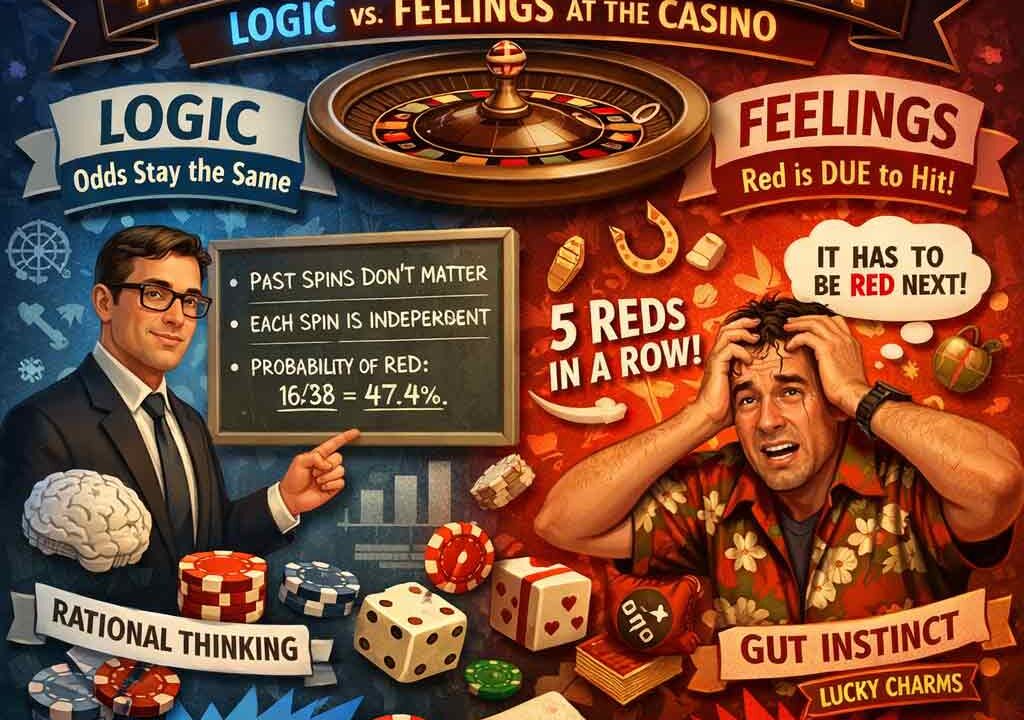

The gambler’s fallacy is one of the most common illusions in games of chance, but probabilities do not change just because we have waited a long time. This fallacy appears among many casino players in Kuwait. In this article, we will explain the fallacy in simple terms: why streaks convince us, how that leads us to make hasty decisions, and what helps us avoid it both in gambling and beyond.
What Is the Gambler’s Fallacy?
The Gambler’s Fallacy is the belief that games of chance follow some hidden logic, leading a player to expect the next result to reverse after a streak of similar outcomes. For example, if red appears repeatedly in roulette, the player may believe black is bound to come next. Or after losing several times in a row, they may think a win is now due because of that losing streak. The core mistake is not in hoping to win, but in misunderstanding the mathematical probabilities of the game
Independent Events
Independent events mean that each spin or round is calculated separately, so what happened before does not turn it into a win or a loss. The previous result does not change the rules of the game, nor does it increase or reduce the probability of the next outcome. In every spin or round, it is as if the player is starting for the first time. So when we say that two events are independent, we mean that knowing what happened last time gives you no useful information about what will happen next, not because prediction is impossible, but because the probabilities themselves have not changed in either event
- Example: Imagine flipping a coin. Even if the result is tails five times in a row, the sixth flip has no connection to the previous ones and is completely independent of them, because the same hand, the same coin, the same flipping method, and the same probability rules have not changed. That is why the chance of getting heads on the next flip remains exactly 50%, no more and no less
Why Do We Feel the Outcome Must Change After a Streak of Repetition?
The reason is that our minds do not like randomness in its true form. We naturally look for order or a clear pattern in anything that repeats in our lives. So when we see the same result happening again and again, we feel that something is off or illogical, or that the next turn must bring something different. Below are two well-known concepts
First: How We Imagine Randomness (Representativeness Heuristic)
We expect random outcomes to look random in the way we imagine them, such as quick shifts and constant alternation between results. So when we see a long streak of one color or one side, it feels unnatural, even though probability tells us that every outcome is possible, even when it repeats
Second: The Law of Small Numbers
This means we tend to treat a small sample of results as if it were a fixed and reliable pattern. We expect just ten spins or rounds to reflect all possible probabilities as if they were one hundred thousand. In reality, balance becomes clearer only as the number of rounds grows, while in small samples, repetition is normal and does not prove that the next result must be different
From all of this, the Gambler’s Fallacy begins to take shape: probability tells us that each attempt is completely independent, while our feelings tell us that a different result must come next. For players at online casinos in Kuwait, this gap between logic and emotion is where hasty decisions often begin, such as placing a much larger bet or making similar impulsive moves
The Gambler’s Fallacy in History: The Monte Carlo Story of 1913
At the Monte Carlo Casino in 1913, an incident took place that is often retold to explain the Gambler’s Fallacy. The roulette wheel landed on black 26 times in a row. With each new spin, bettors became more convinced that red simply had to come next, so many of them increased their bets on red, believing a reversal was close. Instead, many ended up suffering heavy losses by betting against the streak. This story gave the fallacy one of its most famous names: the Monte Carlo Fallacy.
Why Doesn’t a Streak Change the Next Probability?
A streak like black appearing 26 times in a row may seem astonishing because it is rare, but its rarity does not mean the roulette wheel is somehow forced to produce red on the next spin. More accurately, we can say that the streak itself was unlikely, but once it has already happened, the real question becomes: what is the probability of the next spin alone? That probability remains exactly the same, because the rules of the game have not changed.
Where Exactly Does the Mental Error Happen?
The mistake is not only in expecting a different result to appear next, but in a chain of decisions that grows with every round, especially when that expectation turns into psychological certainty. Once that certainty takes over, the Kuwaiti player may begin raising the bet to much higher levels in the following way.
At first, they place a small amount on red, for example, just to test it. Then red does not appear, so they become convinced it must come on the next round. They increase the bet, lose again, then raise it even more in an attempt to recover what they have already lost, and so on. At that point, the Gambler’s Fallacy turns into a double trap.
- The streak creates a false sense that the longer you wait, the closer a change in outcome must be, even though the probabilities have not changed.
- Loss becomes a reason to take bigger risks: instead of serving as a signal to stop, it is used as a justification to raise the bet and recover what was lost.
How Does the Casino Benefit from the Gambler’s Fallacy?
Many online casino players in Kuwait believe that the casino deliberately causes them to lose and manipulates game outcomes. That belief is completely wrong when the casino is licensed and trustworthy. Still, the casino is not entirely innocent, so how does it benefit?
The design of the casino and the overall gaming experience amplify what we already feel about streaks and repetition. It is built to make results appear fast-paced and emotionally charged, turning chance from ordinary numbers into a pattern that seems to grow more meaningful over time. In that sense, the carefully designed visual and sound effects in a casino cannot change the probabilities of the games, but they can absolutely change the way you see them and how you react to them.
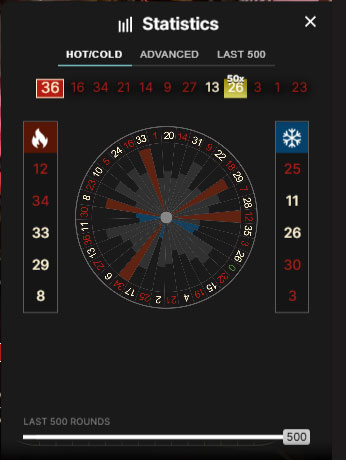
The Casino’s Temptation: The “Recent Results” Board as an Example
Many casino games display recent outcomes on a dedicated results board, or show a chart of the most frequent results in roulette, for example. But when the player looks at this information, they do not read it as something that belongs to the past and is already over. Instead, they use it as a basis for their next choice.
The results board plays a strong psychological role here, making randomness seem as if it has a direction and tempting the eye to interpret repetition as a fixed pattern
Although the board displays real and accurate data, the problem is that the human mind does not stop at simply reading data. It tries to turn it into a familiar pattern, imagining that the repeated streak has reached its limit and is about to break. In this way, information that should be neutral becomes a trigger for a non-neutral decision and a temptation to bet more
Why Does a Player’s Risk Increase After a Loss?
Losing a bet or a round does not feel like a simple annoyance. It creates a very strong urge to recover what was lost as quickly as possible. At this point, a common behavior appears among casino players: increasing the bet in an attempt to make up for the loss. But this increase does not come from better odds. It comes from involuntary psychological pressure
The player feels that the next win will restore balance and end the tension, so increasing the bet starts to seem like a shortcut and a way to speed things up. One big win feels more appealing than several small gains. As losses continue, stopping becomes emotionally harder because leaving feels like a final admission of defeat. That is how risk-taking grows—not because the odds have improved, but because the urge to recover losses has become stronger
That is why it can be said that the casino does not need to manipulate results or engage in deception, because this mental tendency already exists within us. All the design does is make it easier to fall into the Gambler’s Fallacy through striking visual and audio effects, making impulsive decisions easier and stepping back much harder