


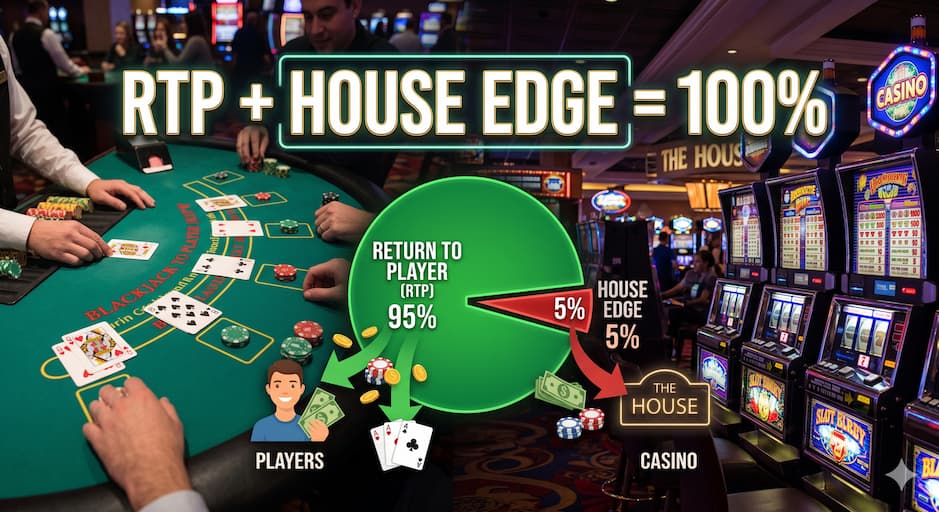

RTP and house edge are what keep the online casino ecosystem functioning, creating a perfect balance between players and the operators. They are opposite sides of the same coin. They mean opposite things, but when you know one, you can know the other. Think of it as a pizza you bought: the house edge is a slice that the casino takes, and the remaining (RTP) is yours to eat. Surely, it is more complicated than that, and that’s what we will discuss in this article today to give you a full understanding of RTP and house edge.
Calculating RTP & House Edge: The Formula
We said that RTP and house edge are two sides of the same coin. This is because if you know one, you can calculate the other through this formula. As for how each is calculated, we will explain in detail below.
RTP + House Edge = 100%
Calculating the House Edge:
House Edge= (True Odds – Payout Odds) x Probability of Winning
Example: Straight Up Bet in Roulette (European)
- True Odds: There are 37 numbers. 36 to 1 (Because there are 37 numbers total, you have 1 way to win and 36 ways to lose).
- Payout Odds: The casino pays 35 to 1.
- Probability of Winning: There are 37 numbers, so 1/37.
- The Calculation: (36 – 35) x 1/37 = 0.0270 or 2.7%
Calculating the RTP
RTP = (Total Win / Total Bet) x 100
Example: 5000 Bets on an Online Slot
Let’s say you have been playing a certain slot for 4 hours. The total bet you have placed so far mounts to $5,000. After a rollercoaster of wins, losses and bonuses and free spins you have won a total of $4,800.
The calculation is As follows: RTP = 4800 / 5000 = 0.96 x 100 = 96% Thus this slot’s RTP is 96%.
This is how companies that ensure fair play by monitoring online casinos calculate the Return to player of each game. They make sure it is indeed as much as the casino claims by testing long periods of betting.
The Common Misconception That Fools Players
Here is something we notice some of our Kuwaiti players get confused with. They think a 96% RTP means if they play $100, they will get $96 back. While the concept is true, the time period whereby it applies makes the difference. This RTP is calculated for long periods of play. It is expected that the casino will make a 4% profit from this game and player over long sessions and maybe hundreds of rounds, not just a $100 bet.
Now you may wonder then how players sometimes win big amounts—short-term wins. If you win $5,000 from $100 bets, rest assured the math will even out if you keep playing for a long time after having won.
How RTP & House Edge Protect the Player
Some may think it is unfair that the casino takes a certain percentage, but it is actually how the whole gambling ecosystem—be it online or on land—is balanced. The RTP and house edge guarantee fair play, and we will show you how.
Independent Testing and Fairness Certification
Before a game is released, independent testing agencies like eCOGRA and iTech Labs verify that it behaves exactly as the casino and software provider claim. They run millions of simulated spins using mathematical models to check that the Return to Player matches the advertised percentage over the long term. These labs also test randomness using certified RNG (Random Number Generator) systems to ensure no manipulation or bias. If a game does not meet the required fairness standards, it is not certified and cannot be legally offered by licensed casinos, effectively enforcing compliance with strict payout expectations.
Regulatory Licensing and RTP Enforcement
After independent labs certify the game, gambling regulators (such as the Malta Gaming Authority or UK Gambling Commission) step in to ensure casinos actually follow the approved math in real operation. They require operators to use only certified game versions and maintain the declared RTP range, meaning casinos cannot secretly alter payout rates to gain an unfair advantage. Regular audits, compliance checks, and financial reporting help ensure that the house edge stays within regulated limits, keeping both the player protection rules and the fairness standards enforceable in practice.
Common House Edge & RTP Across Several Casino Games
| Game Type | House Edge Range | RTP Range | Why the range? |
|---|---|---|---|
| Roulette | 1.35% – 5.26% | 94.74% – 98.65% | 1.35% is French Roulette (La Partage); 5.26% is American ($00$). |
| Blackjack | 0.5% – 2.0% | 98.0% – 99.5% | Depends on the number of decks and if the dealer hits on Soft 17. |
| Baccarat | 1.01% – 1.24% | 98.76% – 98.99% | Varies slightly between Banker and Player bets. |
| Online Slots | 1.0% – 12.0% | 88.0% – 99.0% | Most “good” slots are 3%–5%; Jackpots are 10%+. |
| Video Poker | 0.5% – 5.0% | 95.0% – 99.5% | Depends entirely on the “Paytable” (e.g., what a Full House pays). |
| Craps | 0.0% – 16.7% | 83.3% – 100% | “Odds” bets have 0% edge; “Proposition” bets have 16.7%. |
What Is Volatility & Why It Does Not Affect RTP?
Volatility, also known as variance, measures the risk that describes how much a slot or any casino game will pay out. High volatility games, for instance, have wins that are rare but huge, kind of like the all-or-nothing approach. Low volatility games, on the other hand, pay out frequently in small amounts, more like a slow-and-steady approach.
While volatility does determine how bumpy the ride will be of your playing session, it does not change the RTP or house edge. Think of it like this: the house edge is the price you pay to play, while volatility is the path your bankroll takes. High volatility can mask the house edge with the chance of huge short-term swings, whereas low volatility makes the house edge feel like a predictable, slow drain on your funds.
How To Choose Games Wisely Based on Their RTP?
Now that you understand what RTP, volatility, and house edge mean, it is time to show you how to use them to make smarter choices with the types of games you play. Sometimes even the same game can differ from one site or Kuwait casino site to another.
Set Your Goal
Decide how you want to play. Do you want to play for a long time on a small budget, or do you want to try for big wins with one hit? If it is the first option, then opt for low-volatility games. If it is the second, go for high volatility.
Look for the Lowest House Edge
Look for games where the house edge is under 3%. In table games, this means choosing European Roulette (2.7%) over American Roulette (5.26%), or sticking to Blackjack (0.5%) and Baccarat Banker bets (1.06%). Every percentage point you reduce in house edge is money that stays in your pocket for longer.
Check the Real RTP
Just because the RTP of a slot is 97% on one site doesn’t mean it is the same everywhere—it can be lower on another. Always open the “Game Info” or “Help” section within the game to confirm you are playing the highest available version (aim for 96% or higher).
Avoid the “Bonus Trap”
Don’t be misled by high RTP alone—check if the game is a progressive jackpot slot. Games like Mega Moolah may show a decent RTP, but a large portion is reserved for the jackpot winner. If you’re not chasing the top prize, choose a “flat top” game with a high base-game RTP for more consistent returns.
FAQs About Return to Player
What is RTP?
It stands for Return to Player. It is the average amount a player can expect to get back from playing over a long period of time.
How can I find the RTP of a game?
To find the RTP of a casino game, you check for the “i” icon for information or the “?” for help. The RTP usually appears in the game details or at the bottom of the information section.
Does volatility affect the RTP?
Volatility does not affect RTP. It only means that if the game is volatile, the journey toward reaching the RTP will be bumpier compared to a lower-volatility game.
Can casinos change the RTP of a game?
Yes, in online casinos they can change the RTP of a slot, but there is a minimum imposed by the regulatory gambling authority. For example, a slot can have a Return to player of 97% in one site and 95% in another, but not as low as 80%.